Inheritance Tax (IHT) may be payable when the value of an individual’s estate exceeds £325,000 on death. As IHT rules are complex and subject to change, regular reviews of your estate planning and Will are important to ensure your affairs remain structured in the most tax efficient way. The government confirmed that the Inheritance Tax nil rate band will remain frozen at £325,000 until at least April 2031.
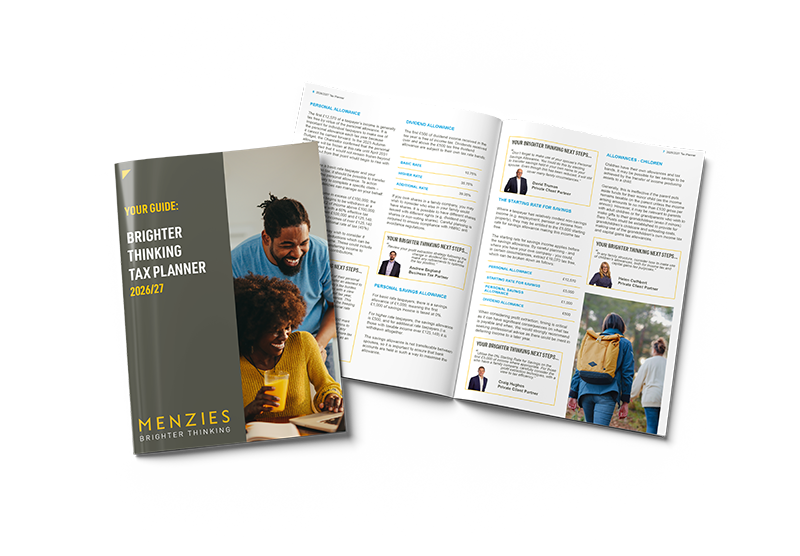
Download our Brighter Thinking Tax Planner
Key changes to Inheritance Tax
Significant reforms were announced in October 2024, including changes to the scope of UK IHT and reliefs available for certain assets.
From 6 April 2025, the UK moved from a domicile-based system to a residence-based regime. This means that an individual’s domicile status is no longer relevant when determining their IHT position. Instead, liability for IHT on non-UK assets will depend on whether the individual is considered a “long-term resident”, generally where they have been UK resident for at least 10 out of the previous 20 tax years.
UK-situated assets will remain within the scope of UK IHT regardless of residence status.
Key exemptions and allowances
There are several exemptions that can help reduce the value of an estate for IHT purposes.
- Individuals can make IHT-free gifts of up to £3,000 per tax year, or £6,000 if the previous year’s exemption was unused.
- Married couples may therefore gift up to £12,000 in one tax year if neither used the exemption in the previous year.
- Gifts made from normal expenditure out of income may also fall immediately outside of an individual’s estate if certain conditions are met.
Where an individual passes their home to a direct descendant, an additional Residence Nil Rate Band of up to £175,000 may be available. Any unused allowance can be transferred to a surviving spouse or civil partner.
Business and agricultural property relief
Business Relief (BR) can reduce or eliminate IHT on qualifying business assets. However, the rules are complex and relief is not always available even where the conditions appear to be met.
From 6 April 2026, reforms will apply to Business Relief and Agricultural Property Relief:
- 100% relief will apply to the first £2.5 million of qualifying assets
- Assets above this threshold will receive 50% relief
The £2.5 million allowance will be transferable to a surviving spouse.
Pension changes
Pensions have historically been an efficient way to pass wealth between generations. Currently:
- If death occurs before age 75, pension funds can be passed to beneficiaries tax free
- If death occurs after age 75, beneficiaries are taxed at their marginal income tax rate
However, from 6 April 2027, unused pension funds and death benefits will be included within an individual’s estate for IHT purposes, potentially increasing the overall inheritance tax liability. Estate planning considerations
Effective IHT Planning
Effective IHT planning often involves reviewing several areas of your financial affairs, including:
- Keeping your Will up to date
- Reviewing death benefit nominations on pensions
- Considering the use of trusts or family investment companies
- Planning for gifts and wealth transfers during your lifetime
Early planning can help ensure your estate is structured efficiently and that your wealth is passed to future generations in line with your wishes.
Download the full 2026/27 Tax Planner for more detailed guidance on inheritance tax planning and recent legislative changes.
Key insights
Hear from our experts

Corporate Interest Restriction: A Practical Guide for Businesses
Introduction Corporate Interest Restriction (“CIR”) is one of the UK’s most significant anti-avoidance measures affecting…

Inheritance Tax on Pensions: What the New Rules Mean for You
For years, pensions have been one of the most tax-efficient ways to pass on wealth…

The Accounting Direction for Private Registered Providers of Social Housing in England – 2026 Update
The Regulator of Social Housing has published an updated version of the Accounting Direction for…

Insolvencies on the rise: inside the struggles of UK construction
With Property and Construction (‘P&C’) typically the number one sector for insolvencies in England &…

10 Ways to Prepare for a More Efficient Corporation Tax Return
A few simple steps can help companies prepare for their corporation tax return more efficiently,…

FRS 102 changes: key tax considerations for privately owned businesses
The upcoming changes to FRS 102 apply to accounting periods beginning on or after 1…

Construction continues to be a major weakness in the Welsh economy
The latest insolvency figures highlight serious concerns for the UK economy. According to the Insolvency…

Mind the Asset Ceiling: Pension Accounting in Education
Many Colleges and Academies are already reporting Local Government Pension Scheme (LGPS) surpluses, with those positions continuing to…

Tax Provisioning and Tax Accounting
Tax provisioning and tax accounting are increasingly becoming critical components of corporate governance and financial…

Accounting for Change: Mergers and Acquisitions in the FE Sector
The further education sector continues to experience structural change, with mergers, group restructures and strategic…
Probate
Having supported you throughout your working life and then into your retirement, we are also experienced in dealing with and providing probate advice and estate advice.
Although probate matters are not traditionally viewed as a “year-end” matter, taking the time to consider the provisions you want to make for the future should be at least an annual assessment. As the trusted advisor, we aim to support your family and beneficiaries at the times we are needed. We have specially qualified partners and staff who can assist with a wide range of services. We also have partners who are able to act as Executors and Trustees, if required, along with members of your family.
We feel that we are well placed to provide probate services, having worked with you throughout your life to create a plan for your wealth. As accountants, we believe that we are well suited to the provision of probate services, as we specialise in accounting, taxation and administration. We also have a number of STEP qualified members within our team.
“Undertake an annual assessment of your own wishes. Assess whether you would like Menzies to assist with probate matters in the future; consider updating your Wills accordingly such that your family members do not have to decide on this in the future.”
Craig Hughes – Private Client Partner